

What Is CAA and Why Do Its Fee Rules Matter?
The Circular Action Alliance is the designated Producer Responsibility Organization (PRO) responsible for administering packaging EPR programs across multiple U.S. states. Its role includes:
- Setting program budgets
- Collecting producer fees
- Allocating funds for system improvements
- Creating fee schedules
- Applying eco-modulation rules
- Providing reporting templates and validation processes
Because many states are using CAA as their PRO, CAA’s methodology is rapidly becoming the de facto national standard for EPR cost modeling.
What EPR Fees Actually Fund:
At their core, U.S. packaging EPR laws are designed to shift the financial responsibility for managing packaging waste from taxpayers and municipalities to the companies that place packaging onto the market.
The intention is not only to create a fairer system, but to modernize and stabilize America’s recycling infrastructure—which today is fragmented, underfunded, and uneven across states.
EPR fees are intended to fund curbside recycling services, collection and sortation improvements, new infrastructure for hard-to-recycle materials, standardized education and contamination reduction programs, litter abatement, market development for recycled materials, and the administrative and oversight costs required to run these systems.
In other words, EPR laws ensure that producers help build the recycling system their products require—giving states a dedicated, long-term revenue stream to improve circularity and reduce environmental impact.
EPR laws are intended to create a state level closed-loop system where producer fees directly improve recycling outcomes within that same state.
CAA’s Guiding Principles for Fee-Setting
The Circular Action Alliance structures its fee-setting methodology around a clear set of guiding principles designed to ensure national consistency, fairness, transparency, and environmental integrity. These principles shape how program budgets translate into per-kilogram material fees and how producers’ design choices influence costs. You can hear directly from Savannah in this webinar on EPR fees.
1. Harmonization
Fee rates are built using a national methodology, ensuring consistency across states wherever possible. While state-specific laws and data inputs will still cause variations, the underlying framework remains aligned—reducing the administrative burden on multi-state brands.
2. Fairness
All producers supplying covered materials must contribute equitably to the true cost of the recycling system. This includes materials that are not currently collected, processed, or recycled—ensuring every producer pays their fair share based on impact.
3. Material-Specific Costs
CAA uses the best available data to determine state-specific management costs for each material category. Materials that are more expensive to collect or sort will have higher fees, while widely recyclable materials with lower system costs will have lower fees.
4. Commodity Revenue
State-specific commodity revenues are incorporated directly into the fee calculation. Where materials generate value (e.g., aluminum, certain grades of PET), those revenues are allocated back to the corresponding material category to reduce producer fees.
5. Eco-Modulation
Fee-setting includes measurable adjustments for environmental performance, reflecting both state requirements and CAA’s own eco-modulation framework. Packaging that is recyclable, reusable, low-impact, or high in PCR may receive fee reductions, while hard-to-recycle formats may incur penalties.
6. Responsible End Markets
Fee-setting takes into account the need to build and maintain viable, responsible end markets for each material category. Investments in markets—whether for plastics, fiber, or glass—are costed into material fees to create a circular and resilient system.
7. Clarity
CAA commits to preparing all fee-setting materials and consultations in a transparent, clearly communicated manner, ensuring producers understand the principles, inputs, and calculations behind their fees. This transparency helps brands forecast costs and design packaging more strategically.
CAA’s Program Budget Assessment Framework: Program Cost Components Used to Establish Producer Fees
EPR producer fees are based on the full system costs required to collect, sort, process, and recycle packaging in a particular state.
These costs fall into three major categories: collection, post-collection, and program administration & regulatory oversight.
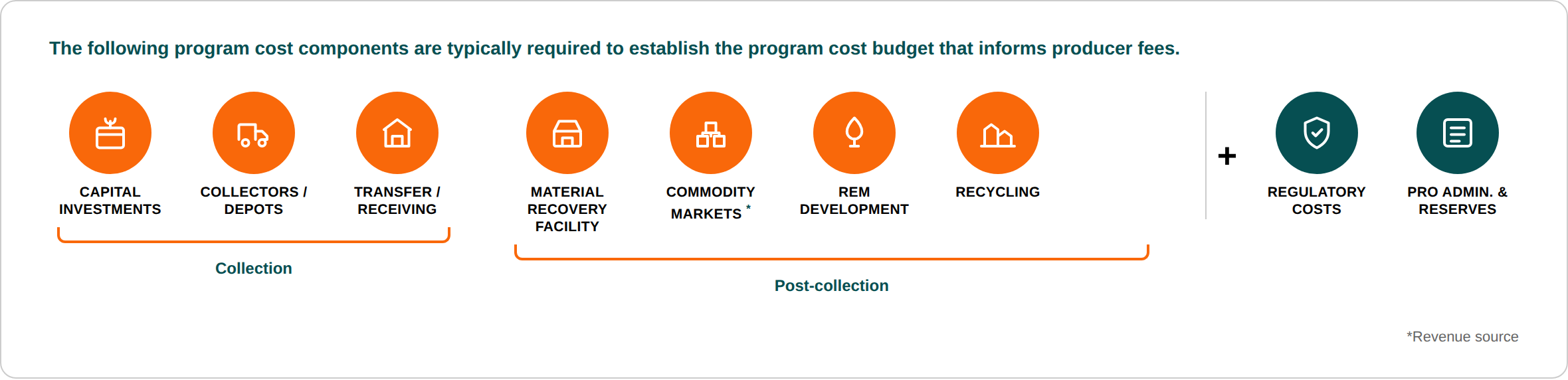
- Waste Material Collection Costs: These are the costs associated with gathering packaging materials from households and businesses:
- Capital investments
Equipment, infrastructure, and major assets needed to operate the recycling system. - Collectors / Depots
Local collection operations, including curbside pickup, drop-off depots, and labor. - Transfer / Receiving stations
Facilities that consolidate and move collected materials to processing centers.
- Capital investments
- Post-Collection Recycling and End of Life Management Costs: These cover everything that happens after materials are collected:
- Material Recovery Facility (MRF) operations
Sorting, baling, and preparing materials for recycling. - Commodity markets (revenue source)
Revenue or cost offsets from selling sorted recyclables into end markets. - REM (Responsible End Market) development
Funding to create or expand responsible, domestic recycling end markets. - Recycling processing
The actual recycling operations that turn sorted materials into usable feedstock.
- Material Recovery Facility (MRF) operations
- Program Administration & Oversight: These are statewide and PRO-level costs that ensure the system runs effectively:
- Regulatory costs
Government oversight, compliance monitoring, enforcement, and reporting systems. - PRO administration & reserves
CAA’s operational costs, reserve funds, data systems, audits, and long-term program management.
- Regulatory costs
CAA compiles these into a total annual program budget, which forms the basis of fee-setting for the program year.
How Program Budgets Are Translated Into Producer Fees
The Circular Action Alliance converts each state’s total EPR program budget into producer fee rates using a structured, step-by-step national methodology. The goal is to ensure that every producer pays a fair share of the system costs based on the material types and quantities they place on the market.
1. Determine the Total System Costs
CAA begins by calculating all costs required to run the recycling system, including collection, transportation, processing, capital investments, access expansion, and service improvements. This represents the full annual funding needed for the program.
2. Allocate System Costs to Each Material Type
Those total costs are then distributed across material categories (e.g., PET, HDPE, PP, paper, glass, aluminum) based on how expensive each material is to collect and manage. Harder-to-recycle or more costly materials receive a higher portion of the budget.
3. Apply Commodity Revenues to Reduce Costs
For materials that generate value in commodity markets—such as metals or certain plastics—CAA subtracts expected revenue from the cost burden of that material. This reduces the fee rates for materials that create market value.
4. Add Non-Material Management Costs
Next, CAA allocates the remaining program needs—like education and outreach, regulatory costs, reserves, and PRO administrative expenses—across materials. These are the systemwide expenses every material category helps fund.
5. Calculate Net Fees by Material Type
After cost allocations and commodity revenue adjustments, CAA determines the net cost attributable to each material type. This reflects the true financial burden each material places on the system.
6. Divide by Producer Supply Tons
The net cost for each material type is divided by the total tons of that material supplied by producers in the state. This step converts costs into a fee rate per pound or per kilogram for each material category.
7. Apply Eco-Modulation Adjustments
Finally, CAA applies eco-modulation—bonuses or penalties based on recyclability, PCR content, design-for-recycling characteristics, and environmental performance. This rewards better packaging design and increases costs for materials that hinder system performance.
The Result: Material-Specific Fee Rates
Producers ultimately pay:
Fee Rate (per lb/kg) × Total Weight of Each Material They Sell in the State.
This methodology ensures that fees directly reflect real system costs, environmental impact, and design choices—creating both financial fairness and a long-term incentive to design better packaging.
What Producers Should Do in 2026
1. Measure packaging accurately, down to components
Eco-modulation requires sub-component precision.
2. Build a harmonized dataset
One dataset mapped to all EPR states is essential.
3. Run early fee simulations
Estimate fee exposure across OR, CO, CA, WA.
4. Review packaging designs against upcoming eco-modulation rules
Identify redesign opportunities early so you can start optimizing your packaging.
5. Implement PCR documentation workflows
CAA requires verifiable PCR records.
How rePurpose Global Helps Producers Navigate CAA Fee-Setting
Our platform is designed to align directly with CAA’s methodology:
✔ Component & Sub-Component Mapping
✔ State-Level Sales Allocation Modeling
✔ Automatic Material Categorization
✔ Eco-Modulation Forecasting
✔ Audit-ready Documentation
✔ One Dataset → All State Reports
Submit to OR, CO, CA, MN, MD, WA, ME using one harmonized system.
FAQs
How does CAA determine EPR fees?
Fees are based on program budgets, material weights, category fee rates, and eco-modulation adjustments. The methodology is standardized across states.
What is eco-modulation?
A system that rewards recyclable, low-impact packaging and penalizes hard-to-recycle formats.
Do all states use the same fee categories?
No, each state has different categories and different corresponding fees, based on their state-level infrastructure and program requirements.
Final Takeaway
CAA’s fee-setting methodology is rapidly becoming the backbone of U.S. packaging EPR. Brands that prepare early—by harmonizing packaging data, validating material weights, and modeling eco-modulation impacts—will navigate 2026–2030 with clarity and cost control.
This is the moment to build internal capacity, upgrade data workflows, and redesign packaging strategically. Learn how the rePurpose Packaging Sustainability and Compliance Platform can help.
Related posts
.png)

.avif)