
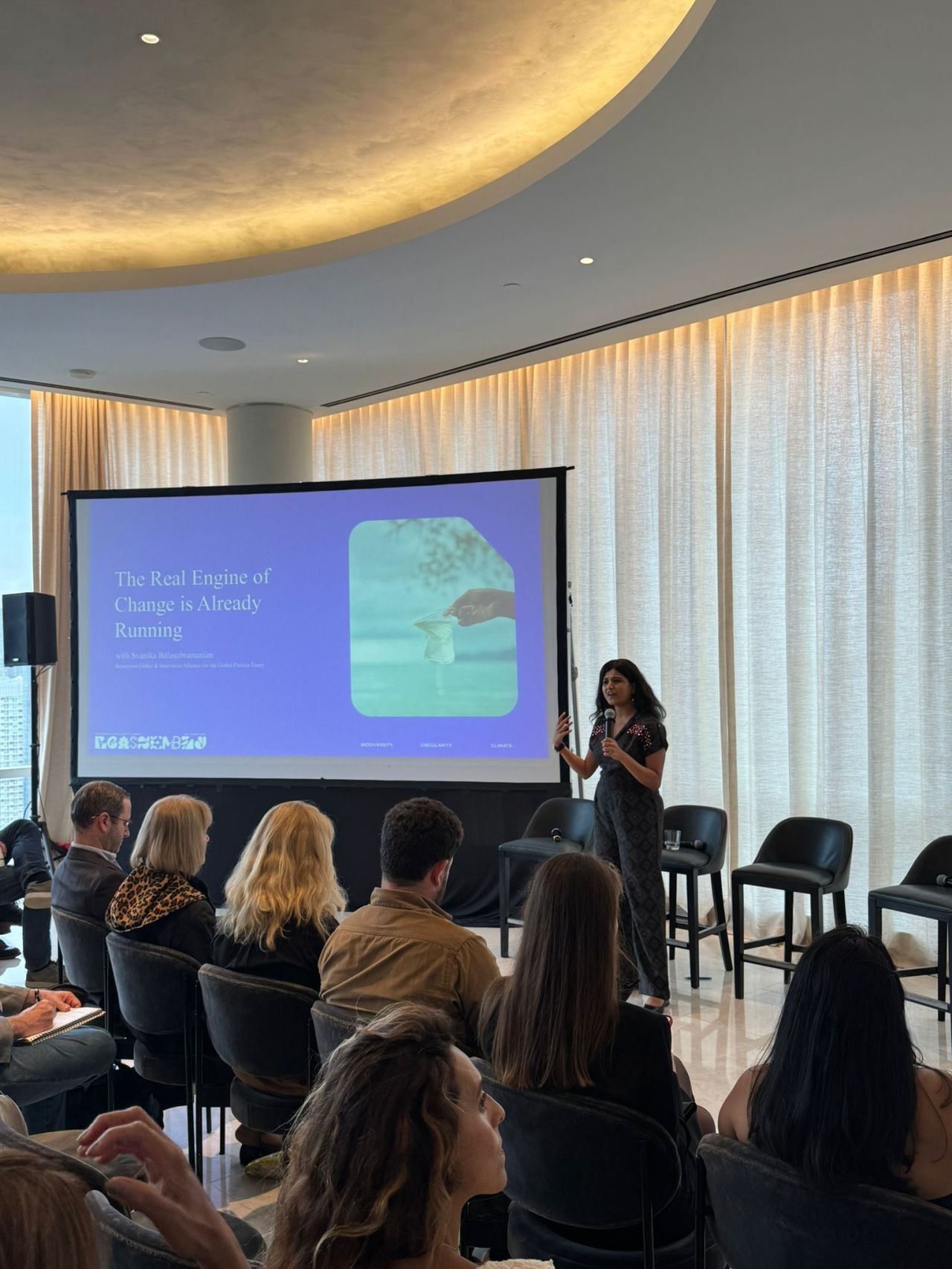
Earlier this year, I had the opportunity to deliver a keynote speech at ReAssembly during New York Climate Week. Organized by Regeneration VC, the event, in their words “convened hundreds of leaders from finance, business, policy, non-profits, academia, and beyond to advance bold solutions for biodiversity, circularity, and climate”.
As I braved the Hudson Yards wind tunnel that cold September morning, the rain outside felt fitting - just a few weeks prior the UN Global Plastics Treaty had been met with some difficult roadblocks and the stagnation had left the ecosystem disappointed and unsure of the road ahead.
Inside the venue, however, the atmosphere was electric: founders, investors, policymakers, and activists all gathered with a shared belief that we can still bend the arc of the plastic crisis toward progress. I left feeling energized and inspired, grateful for the opportunity to be working alongside people with the grit and passion to keep pushing forward.
Below is a loosely edited version of my address to the audience.
Innovations Need to Lead The Way
Now more than ever, it is important for us to lead with innovators at the front, with optimism that policy will follow.
The scale of the plastic crisis is staggering. Humanity now produces over 430 million metric tons of plastic every year, and that number is set to triple by 2060 if current trends continue.
Today, over 3 billion people lack access to formal waste management, allowing plastic to accumulate in rivers, coastlines, and food systems. Microplastics have been found in human blood, breast milk, and even in our cloud systems - a stark reminder that this is no longer something that can be thought of as an “ocean problem” or a “Global South problem,” but a planetary systems level crisis that touches every aspect of human health and ecology.FF
A problem this large, requires not just innovations, but innovations at a global scale.
For us to go beyond the graveyard of pilots, beyond small ideas that work only in pristine lab conditions, and achieve global scale of implementation.
So what does it take to achieve real scale? I have three thoughts on this - one for investors, one for innovators, and one for policymakers.
1. Invest in the Circular Economy as Essential Infrastructure for the Future
I will start by making the case for the most obvious one first. To all the investors in this room - the Circular Economy needs more capital. To tackle mismanaged waste across the planet by 2040 - we need $5.2 Trillion dollars invested across the Circular Economy.
Today, only a fraction of that is flowing. Yes, we’re seeing more blended finance, more late-stage deals. But early-stage investment remains staggeringly low.
WeWork, as a single company, raised double the amount of money in nine years than all recycling startups raised in 24 years.
Often, investments in waste management and circular economy infrastructure have been treated as philanthropy - well-intentioned, but not expected to perform. But the outcomes don’t have to remain as murky anymore. There are several new financing models that help structure investments with more transparency and accountability.
For example, you can read more here about research that rePurpose Global pioneered with Earth Action to develop an outcomes-based financing model that directs capital toward verified environmental outcomes that can be independently measured and validated, meaning returns can be tied to real-world performance, not just goodwill.
So my request to you is this: help us level the playing field. Circular Economy solutions don’t need large multiples like AI. But they can’t keep being treated as discounted, riskier bets either. They are essential building blocks of our future and need to be treated as such.
2. Circular Economy Innovators - Build in the Open
The problems we are solving are far too complex and far too urgent, to not collaborate.
I talk often about this graveyard of pilots. It’s perfectly fine to try things that don’t scale, but what’s inefficient is not extracting any learning from them, leaving others to repeat the same mistakes.
Let me give you an example:
Years ago, before we built rePurpose in its current form - my cofounders and I entered the Circular Economy space with a different product, designed to formalize the waste management ecosystem in the Global South by reducing exploitative middle men. We jokingly used to call it an “Uber for Trash.” It failed spectacularly. My cofounders and I picked ourselves back up, dusted ourselves and moved on.
Now fast forward to a few weeks ago, years after our own experience in this space, I met another founder who had tried the exact same product idea, even called it an “Uber for Trash” - and failed for the exact same reasons we did.
Now to be clear - I am not saying we need to abandon ideas because someone else couldn't make it work. I'm saying we can make ideas better if we don't have to waste resources - time and capital - relearning the same things again and again because we are not sharing enough.
The tragedy wasn’t the failure itself - it was that he wasn’t able to learn from ours and strengthen the idea this time around.
So my plea to entrepreneurs is this: compete on the ground, but collaborate on learnings.
The waste crisis is too complex for parallel experiments that don’t talk to each other. Let’s publish our playbooks, our missteps, and our metrics. Building in the open isn’t a weakness; it’s how we get better faster.
3. Highly Effective Policies Leverage Innovators and the Real World Data We Hold
The third and final point - to the policymakers here - leverage innovators, and leverage real world data.
Circular economy policies cannot exist in a vacuum. They must be informed by what’s happening on the ground.
Let me give you an example:
At rePurpose, we work with brands on packaging measurement and hold hundreds of thousands of data points on the packaging decisions that CPG companies are making.
And here’s the challenge we see: upstream packaging choices are idiosyncratic, each brand makes its own decisions. But downstream infrastructure is shared. And often, there is absolutely no way for one to inform the other even though they absolutely should be.
You can read more about my thoughts on the need for data harmonization here.
Policy has the power to harmonize these decisions. But only if it leverages the data innovators already hold. If we don’t bring innovators into the policymaking process, we risk building rules that look good on paper but collapse in practice.
The Real Engine of Change is Already Running - Some Final Thoughts
Despite the policy gridlock, I’m deeply optimistic.
I am energized by those who keep showing up - every week I meet innovators, recyclers, and brands who refuse to wait for perfect conditions. They’re building systems, creating livelihoods, and showing that change takes grit and persistence. Their resiliency gives me hope.
The real engine of change is already running. The question is no longer if it will move forward, but how fast, and how far.
And in this defining decade - I am optimistic that each of us has the capacity to open and accelerate the floodgates of change
And billions of lives, present and future, will be shaped by how boldly we choose to act today.
Author’s Note:
This piece is adapted from the script of my keynote at ReAssembly, New York Climate Week 2025.
Related posts
.png)

.avif)