
ResourcesBlog
How to Integrate Purpose Into Your Brand the Right Way:

How to Integrate Purpose Into Your Brand the Right Way:

Written by 
Svanika Balasubramanian
Published on 
December 14, 2025

Key Takeaways From the Brand Innovators “Crafting Powerful Brands” Summit

Earlier this month, I had the opportunity to speak at the Brand Innovators “Crafting Powerful Brands: From Challenger to Champion” Summit, an event designed to unpack how today’s most forward-thinking companies build trust, loyalty, and real competitive advantages. 

Hosted at Danone’s North America HQ in White Plains, the event brought together leaders across marketing, sustainability, and brand strategy, providing “A 360° view of what it takes to build, grow, and sustain meaningful brands today”.

I joined Meriel Peterich from FreshPet on a panel moderated by TransUnion, where we explored how purpose shapes decision-making, drives consumer connection, and ultimately fuels long-term business resilience. 

The conversation was honest and energizing, reflecting a shared belief that purpose isn’t a “nice-to-have”—it’s increasingly a strategic requirement.

Below are my 5 biggest takeaways from the discussion.

1. A Brand’s Purpose Cannot Sit in a Silo - It Has to Live Across the Business

One of the biggest risks for sustainability initiatives is organizational isolation. When purpose sits on an island - within a CSR team, an ESG team, or a single executive’s portfolio - it’s easy for it to be deprioritized, underfunded, and eventually seen as a cost center rather than a value driver.

Purpose only becomes durable when:

  • It shows up in product and packaging decisions
  • It’s reflected in supply chain standards
  • Marketing and comms teams know how to talk about it
  • Finance understands its commercial and reputational upside
  • Leadership sees it as a strategic pillar, not a discretionary spend

When purpose is integrated into the operating rhythm of the company, it becomes far harder to cut, and far easier to scale. This is especially true in moments of economic pressure, where sustainability work is often the first to be questioned. But when it’s tied to customer preference, retailer expectations, compliance readiness, and long-term brand equity, it becomes a non-negotiable part of the business model.

Longevity comes from an authentic integration of purpose with the brand, across all departments.

2. Purpose Can Evolve as the Business Matures, But the “Why” Stays Constant

Meriel shared Freshpet’s evolution beautifully during our panel.

Freshpet started with an extremely authentic purpose - helping pets live their best, healthiest lives. Their first innovation, the Freshpet fridges you can find in brick and mortar stores mean that instead of prioritizing for shelf-stabilization, Freshpet can use fewer preservatives, higher-quality fresh ingredients, and gentler cooking methods that preserve more nutrients.

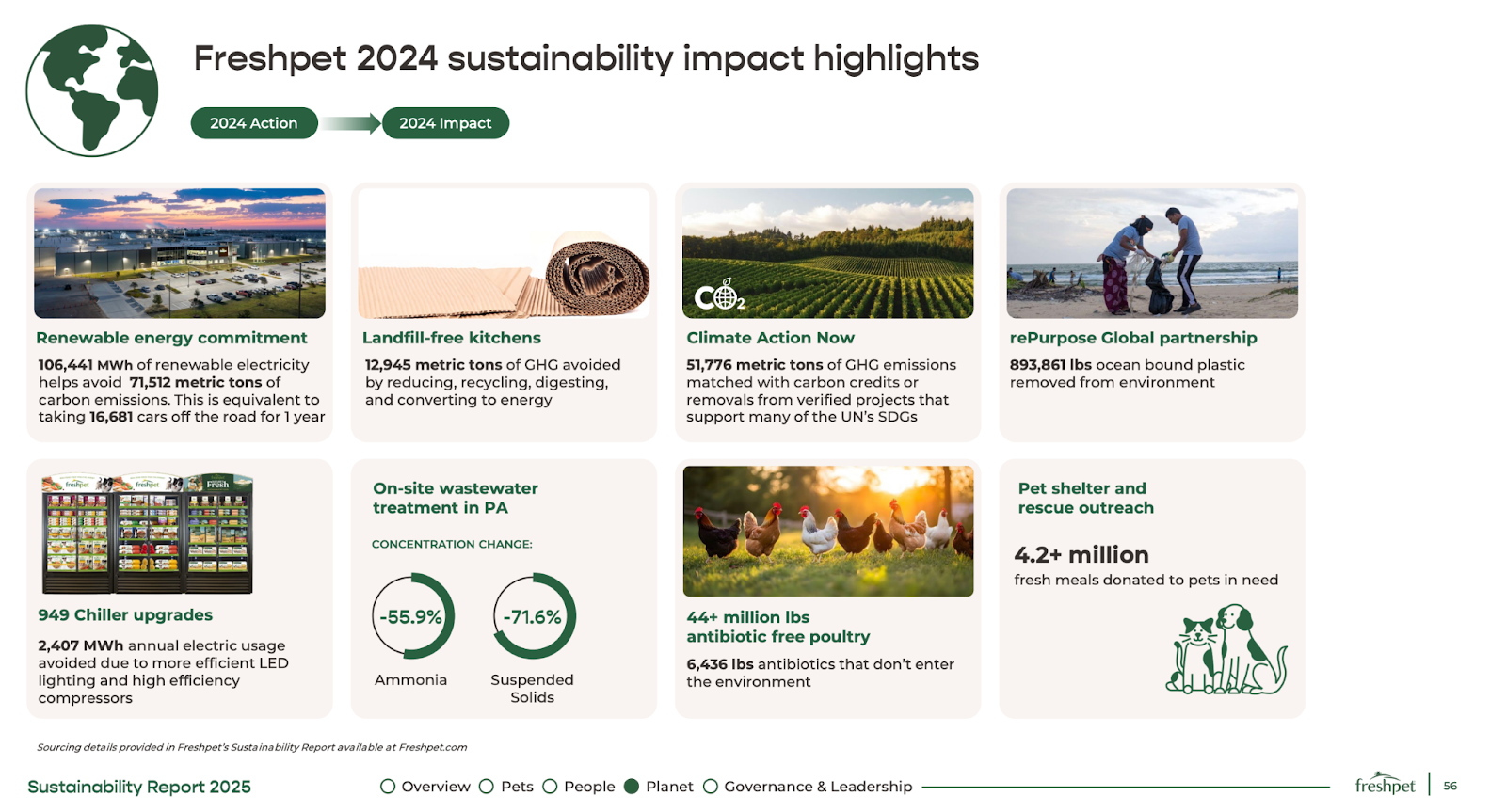
But over the years, the company has strengthened and scaled its purpose to go beyond. If you look through their latest Sustainability Report, the evolution is clear:

  • Early years: Focus on natural, healthy ingredients for pets
  • Growth phase: Investment in energy-efficient kitchens, reducing Scope 1 and 2 emissions
  • Recent years: Stronger commitments around recyclability, packaging improvements, and responsible sourcing
  • Future commitments: A pathway for climate goals, water efficiency, and circular packaging

Their purpose has been consistent. But its expression has matured with the company’s scale, resources, and customer expectations.
This is the reality for most purpose-driven brands: You start with a clear why, but you can scale and iterate the how over time.

3. Choosing the Right Partners Is One of the Most Important Decisions You’ll Make

No brand can be an expert in every dimension of ESG, sustainability, and responsible business. The landscape is too technical and too fast-moving for that. Which means the partners you choose will either accelerate your purpose or dilute it.

The best partners are those who can provide:

  • Transparent, auditable data
  • Field credibility and independently verified standards
  • Dollar-efficient impact with measurable outcomes
  • A long-term, systems-level approach—not band-aid solutions

This is where Freshpet’s partnership with rePurpose Global is such a powerful case study.

A Quantitative Look at Impact

Through our multi-year partnership:

  • Freshpet has funded the recovery of over 2 million pounds of plastic waste from environments where it would otherwise be burned or leaked.
  • Their investment supports hundreds of waste workers annually across vulnerable coastlines, improving earnings stability and working conditions.
  • For every $1 invested in verified plastic recovery, Freshpet is able to trace exactly where, through what methods, which environmental and socioeconomic outcomes were generated. 
  • The partnership has also increased Freshpet’s ability to confidently communicate progress in customer-facing channels, strengthening brand trust.

Purpose becomes real when companies choose partners who can quantify, verify, and sustain impact at scale.
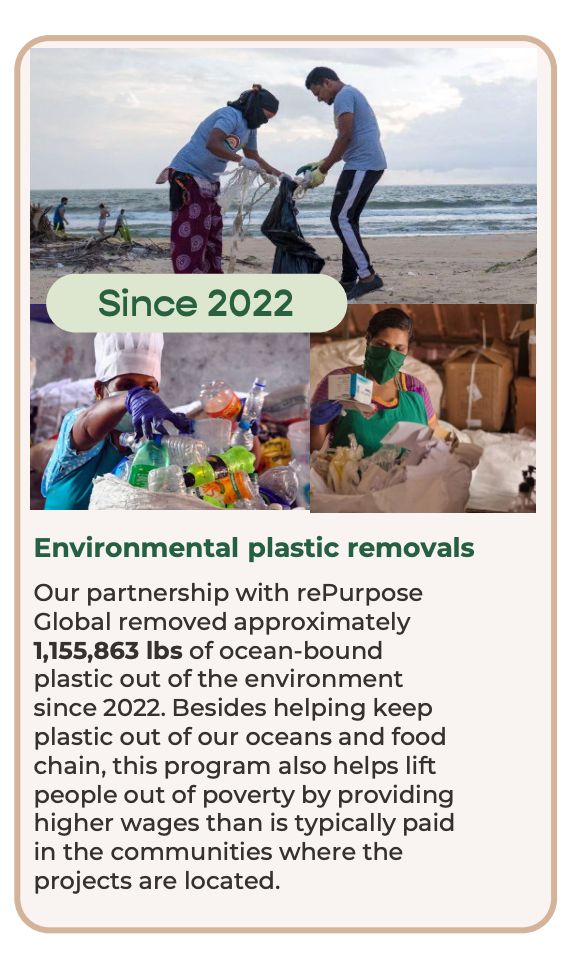
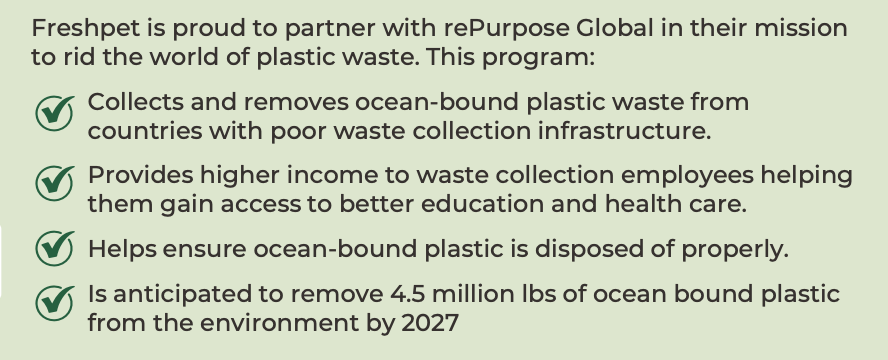
Read more about their partnership in their 2025 Sustainability Report. 

4. Internal Resistance Is Real—But Measurable Data (and Patient Iteration) Moves Things Forward

Every company encounters friction when pursuing purpose-led work: competing priorities, questions about ROI, short-term cost pressures, skepticism about consumer interest - the list goes on. 

Resistance is normal. What matters is how you move through it and the answer almost always comes down to data plus deliberate communication.

Here’s what I shared at the panel: 

Brands iterate email subject lines 10 times to get a 0.5% lift. They test campaign creative relentlessly. They A/B test landing pages weekly. But when it comes to sustainability messaging, many companies send one announcement, assume customers “didn’t care,” and deprioritize it.

Purpose deserves the same discipline you apply to marketing.

Be explicit about what signals matter:

  • Customer loyalty
  • Brand equity
  • Shopper preference at the aisle
  • Retail partner feedback
  • Employee engagement

And take an education-first approach. If consumers don’t understand your impact work yet, simplify it, don’t abandon it.

Clarity + consistency beats one-off communications every time.

5. Great Purpose Led Brands Aren’t Perfect, They’re Consistent and Transparent

I often talk about “progress in pursuit of perfection.” The path to sustainability is complex and deeply imperfect:

  • Sometimes the ideal solution doesn’t exist yet technologically.
  • Sometimes you make the wrong call before you know better.
  • Sometimes supply chain constraints limit your options.

Consumers understand this. What they don’t tolerate is silence.

The brands that build trust are the ones who:

  • Share honest timelines
  • Explain trade-offs
  • Report both progress and setbacks
  • Stay engaged even when solutions are messy
  • Show that they are learning in public

Perfection is not the requirement for credibility. Consistency and transparency are.

And when done well, transparency becomes a competitive advantage, not a vulnerability.

Closing Thought

Purpose is not a marketing asset, it’s an operational philosophy. When it’s integrated into decision-making, evolution, partnerships, communication, and transparency, it becomes one of the strongest engines a brand can build.

At the end of the day, I genuinely believe we can solve the plastic crisis within our lifetimes, but only if we stop treating it as someone else’s problem. Governments cannot solve it alone. NGOs cannot solve it alone. Individual consumers, no matter how committed, cannot solve it alone.

We only make real progress when the private sector participates fully and sustainably. When consumer companies have the tools, incentives, and confidence to act. If we can make this transition work for business as much as it works for the planet, then we unlock the scale, speed, and innovation required to build a truly circular future.

Ready to transform your packaging strategy?

Join 500+ CPG brands who've streamlined their packaging compliance and claims with rePurpose Global.

ResourcesBlog
How to Integrate Purpose Into Your Brand the Right Way:

How to Integrate Purpose Into Your Brand the Right Way:

Written by 
Svanika Balasubramanian
Published on 
December 14, 2025
How to Integrate Purpose Into Your Brand the Right Way:

Earlier this month, I had the opportunity to speak at the Brand Innovators “Crafting Powerful Brands: From Challenger to Champion” Summit, an event designed to unpack how today’s most forward-thinking companies build trust, loyalty, and real competitive advantages. 

Hosted at Danone’s North America HQ in White Plains, the event brought together leaders across marketing, sustainability, and brand strategy, providing “A 360° view of what it takes to build, grow, and sustain meaningful brands today”.

I joined Meriel Peterich from FreshPet on a panel moderated by TransUnion, where we explored how purpose shapes decision-making, drives consumer connection, and ultimately fuels long-term business resilience. 

The conversation was honest and energizing, reflecting a shared belief that purpose isn’t a “nice-to-have”—it’s increasingly a strategic requirement.

Below are my 5 biggest takeaways from the discussion.

1. A Brand’s Purpose Cannot Sit in a Silo - It Has to Live Across the Business

One of the biggest risks for sustainability initiatives is organizational isolation. When purpose sits on an island - within a CSR team, an ESG team, or a single executive’s portfolio - it’s easy for it to be deprioritized, underfunded, and eventually seen as a cost center rather than a value driver.

Purpose only becomes durable when:

  • It shows up in product and packaging decisions
  • It’s reflected in supply chain standards
  • Marketing and comms teams know how to talk about it
  • Finance understands its commercial and reputational upside
  • Leadership sees it as a strategic pillar, not a discretionary spend

When purpose is integrated into the operating rhythm of the company, it becomes far harder to cut, and far easier to scale. This is especially true in moments of economic pressure, where sustainability work is often the first to be questioned. But when it’s tied to customer preference, retailer expectations, compliance readiness, and long-term brand equity, it becomes a non-negotiable part of the business model.

Longevity comes from an authentic integration of purpose with the brand, across all departments.

2. Purpose Can Evolve as the Business Matures, But the “Why” Stays Constant

Meriel shared Freshpet’s evolution beautifully during our panel.

Freshpet started with an extremely authentic purpose - helping pets live their best, healthiest lives. Their first innovation, the Freshpet fridges you can find in brick and mortar stores mean that instead of prioritizing for shelf-stabilization, Freshpet can use fewer preservatives, higher-quality fresh ingredients, and gentler cooking methods that preserve more nutrients.

But over the years, the company has strengthened and scaled its purpose to go beyond. If you look through their latest Sustainability Report, the evolution is clear:

  • Early years: Focus on natural, healthy ingredients for pets
  • Growth phase: Investment in energy-efficient kitchens, reducing Scope 1 and 2 emissions
  • Recent years: Stronger commitments around recyclability, packaging improvements, and responsible sourcing
  • Future commitments: A pathway for climate goals, water efficiency, and circular packaging

Their purpose has been consistent. But its expression has matured with the company’s scale, resources, and customer expectations.

This is the reality for most purpose-driven brands: You start with a clear why, but you can scale and iterate the how over time.

3. Choosing the Right Partners Is One of the Most Important Decisions You’ll Make

No brand can be an expert in every dimension of ESG, sustainability, and responsible business. The landscape is too technical and too fast-moving for that. Which means the partners you choose will either accelerate your purpose or dilute it.

The best partners are those who can provide:

  • Transparent, auditable data
  • Field credibility and independently verified standards
  • Dollar-efficient impact with measurable outcomes
  • A long-term, systems-level approach—not band-aid solutions

This is where Freshpet’s partnership with rePurpose Global is such a powerful case study.

A Quantitative Look at Impact

Through our multi-year partnership:

  • Freshpet has funded the recovery of over 2 million pounds of plastic waste from environments where it would otherwise be burned or leaked.
  • Their investment supports hundreds of waste workers annually across vulnerable coastlines, improving earnings stability and working conditions.
  • For every $1 invested in verified plastic recovery, Freshpet is able to trace exactly where, through what methods, which environmental and socioeconomic outcomes were generated. 
  • The partnership has also increased Freshpet’s ability to confidently communicate progress in customer-facing channels, strengthening brand trust.

Purpose becomes real when companies choose partners who can quantify, verify, and sustain impact at scale.
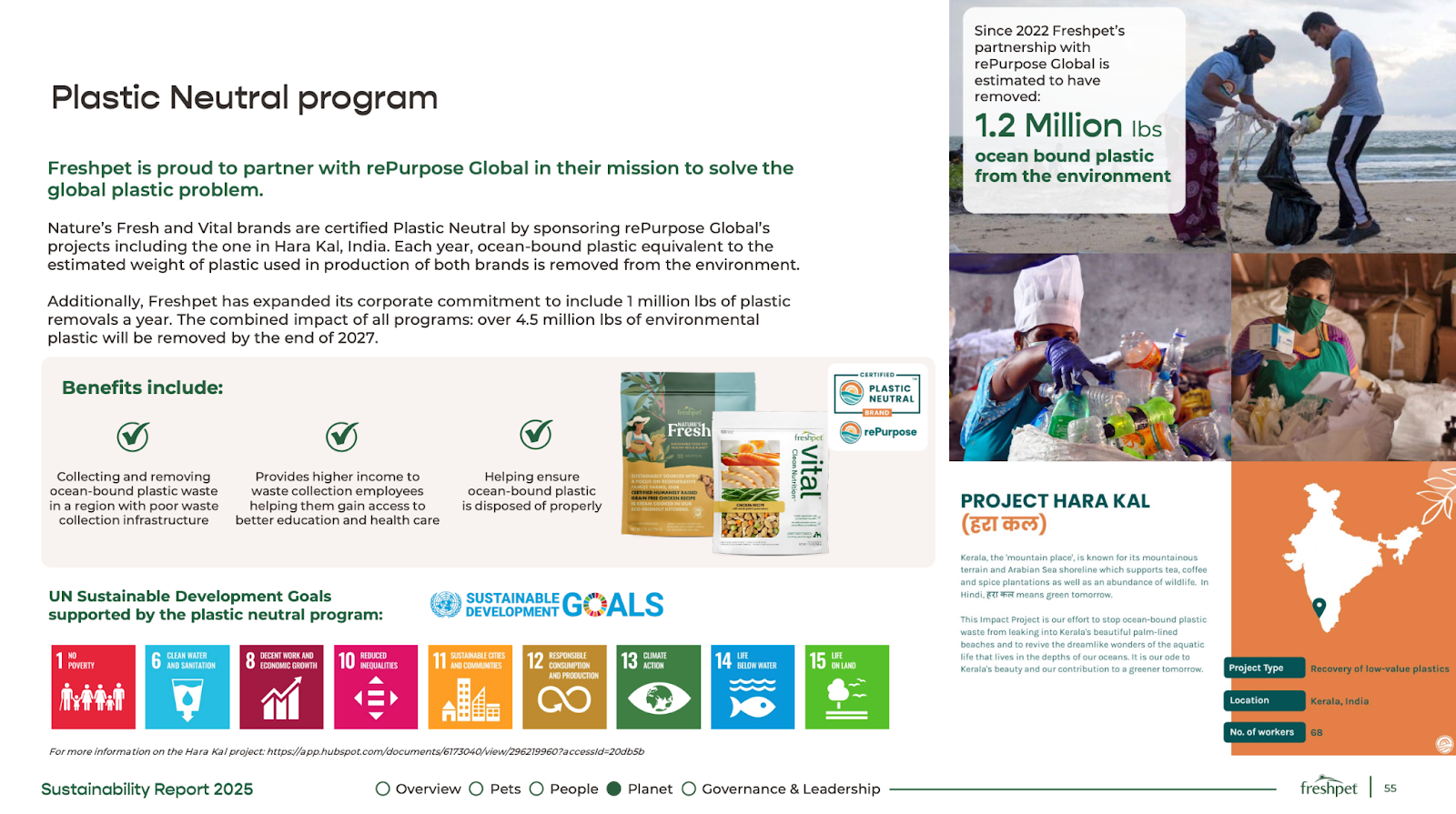
Read more about their partnership in their 2025 Sustainability Report. 

4. Internal Resistance Is Real—But Measurable Data (and Patient Iteration) Moves Things Forward

Every company encounters friction when pursuing purpose-led work: competing priorities, questions about ROI, short-term cost pressures, skepticism about consumer interest - the list goes on. 

Resistance is normal. What matters is how you move through it and the answer almost always comes down to data plus deliberate communication.

Here’s what I shared at the panel: 

Brands iterate email subject lines 10 times to get a 0.5% lift. They test campaign creative relentlessly. They A/B test landing pages weekly. But when it comes to sustainability messaging, many companies send one announcement, assume customers “didn’t care,” and deprioritize it.

Purpose deserves the same discipline you apply to marketing.

Be explicit about what signals matter:

  • Customer loyalty
  • Brand equity
  • Shopper preference at the aisle
  • Retail partner feedback
  • Employee engagement

And take an education-first approach. If consumers don’t understand your impact work yet, simplify it, don’t abandon it.

Clarity + consistency beats one-off communications every time.

5. Great Purpose Led Brands Aren’t Perfect, They’re Consistent and Transparent

I often talk about “progress in pursuit of perfection.” The path to sustainability is complex and deeply imperfect:

  • Sometimes the ideal solution doesn’t exist yet technologically.
  • Sometimes you make the wrong call before you know better.
  • Sometimes supply chain constraints limit your options.

Consumers understand this. What they don’t tolerate is silence.

The brands that build trust are the ones who:

  • Share honest timelines
  • Explain trade-offs
  • Report both progress and setbacks
  • Stay engaged even when solutions are messy
  • Show that they are learning in public

Perfection is not the requirement for credibility. Consistency and transparency are.

And when done well, transparency becomes a competitive advantage, not a vulnerability.

Closing Thought

Purpose is not a marketing asset, it’s an operational philosophy. When it’s integrated into decision-making, evolution, partnerships, communication, and transparency, it becomes one of the strongest engines a brand can build.

At the end of the day, I genuinely believe we can solve the plastic crisis within our lifetimes, but only if we stop treating it as someone else’s problem. Governments cannot solve it alone. NGOs cannot solve it alone. Individual consumers, no matter how committed, cannot solve it alone.

We only make real progress when the private sector participates fully and sustainably. When consumer companies have the tools, incentives, and confidence to act. If we can make this transition work for business as much as it works for the planet, then we unlock the scale, speed, and innovation required to build a truly circular future.

Ready to transform your packaging strategy?

Join 500+ CPG brands who've streamlined their packaging compliance and claims with rePurpose Global.