








#1 Packaging Compliance Platform

EPR compliance – done faster, done right, done for you

  • Report across every EPR state
  • Forecast fees & model source reductions
  • Pay one flat price

Trusted by 100+ Consumer Companies

Ancient Nutrition logoSavencia Fromage & Dairy logoYumearth logoOllie logoProse logoSerenity Kids logoBlueland logoNordic Naturals logoOrganic India logoTillamook logoMedik8 logoIlia logoCurology logo

$100,000 - That's how much rePurpose saved us in EPR fees

“They reviewed our filing and reclassified our materials correctly. The partnership has already paid for itself.”

Smiling middle-aged man wearing glasses and a light blue collared shirt against a white background.

Steve Marko

Senior Director of R&D at Tillamook

The biggest relief is just knowing it's handled by rePurpose

“EPR compliance isn't a one-time project — it's ongoing, it changes, and new states keep coming online.”

Smiling woman with blonde hair taking a close-up selfie with a brown cow outdoors.

Kristie Cerutti

VP Strategic Partnerships & Impact at Ancient Nutrition

rePurpose saved us weeks of work on our EPR reporting

“They stepped in with the tools, insights, and support we needed  —  saving weeks of  work.”

Smiling woman with shoulder-length wavy brown hair wearing glasses and a black top outdoors.

Stephie Volo

Chief Impact Officer 
at Earth Animal

From packaging data to compliance confidence in 3 easy steps

STEP 1

Assess obligations

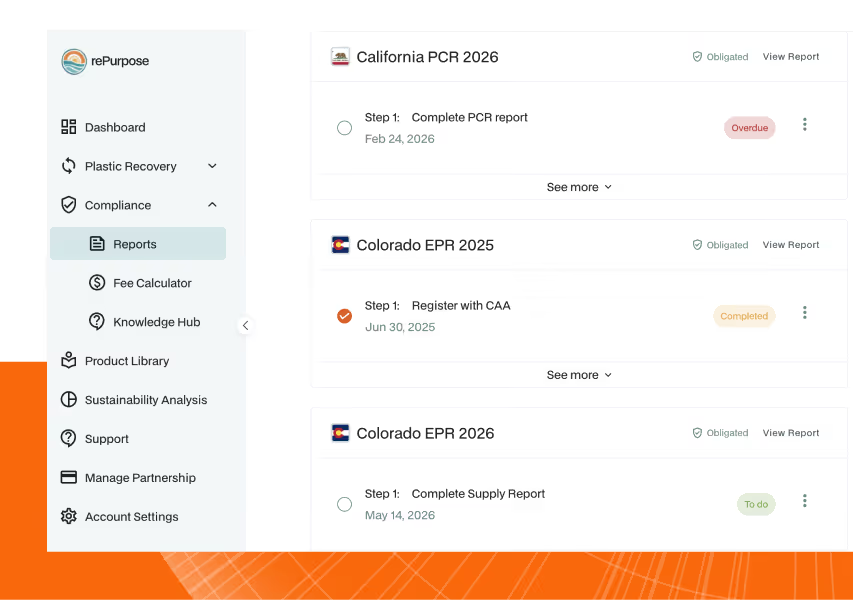
Our team works with you to determine your regulatory obligations and automatically track deadlines.

STEP 2

Compile data

We help you get the right data, then our system categorizes materials and calculates fees.

STEP 3

Submit and forecast

You save time, avoid unnecessary costs, and stay ahead by forecasting future EPR fees.

No cost. No obligation.

What most teams want to clarify before moving forward with EPR compliance

I need to get buy-in and budget approval from our internal stakeholders and leadership. EPR is new territory for us.

We get it. EPR is new for most organizations, and internal alignment is a key step. The companies that start early are able to shape their strategy, avoid last-minute costs, and stay ahead of compliance risk.

We help teams get there by providing ROI benchmarks and real case studies, so you can clearly demonstrate the business case internally.

Our data is too fragmented for reporting, and this feels too complex to pull together. How would we even begin?

You’re not alone. This is one of the most common barriers teams face when approaching EPR. The key is to start with what’s available and build from there.

Our platform structures your existing data, identifies gaps, and helps fill in missing information using our component database. It’s designed to handle fragmented inputs and turn them into compliant, audit-ready reports, without requiring a complete data overhaul upfront.

With EPR regulations constantly evolving, are we really expected to comply? Will we actually get fined?

Enforcement is already underway in several markets, with penalties ranging from financial fines to restrictions on selling for non-compliant producers.

Regulators are increasingly prioritizing producer accountability, and there is a clear expectation that companies comply, along with growing enforcement of penalties for those that don’t.

To confirm your eligibility, take our 5-minute survey

Coverage across North American EPR

Choosing the right approach
for EPR compliance

Features

Other platforms

Consultants

Cut compliance work from 2+ months to ~2 weeks

Real-time regulation tracking

Replace dozens of spreadsheets with one organized system

EPR-specific regulatory expertise (not general compliance)

Guided support so you’re not doing it alone

Optimized fees with AI-powered, expert-verified material categorization

Frequently asked questions

Everything you need to know about streamlining packaging compliance.

Extended Producer Responsibility (EPR) is an environmental regulatory framework that makes brands responsible for the packaging they put into the world. Under EPR, companies must collect, format, and submit packaging data to each relevant state, then pay fees based on the types and amounts of packaging they use.

First adopted in Europe and Canada, EPR was designed to shift the financial burden of waste management from the public sector to producers. All fees will go towards funding state-run recycling programs to improve waste collection infrastructure.

Seven states (Oregon, California, Colorado, Minnesota, Maryland, Washington, Maine) have active EPR laws.

You likely need to comply with EPR if you meet these criteria:


  • Above $5 million in global annual revenue or above $1M in annual revenue in California
  • Commission single-use packaging, paper products, or food serviceware that feature your brand
  • Are a brand owner, importer, licensee, distributor, or retailer with private label products selling into EPR states (such as California, Colorado, or Oregon)


To confirm your eligibility, take our survey and talk to our team.

Non-compliance can result in serious consequences including:

  • Fines up to $50,000 per day in California (fines vary state by state)
  • Sales bans and prohibition from selling products in regulated markets.
  • Public listing as non-compliant.
  • Reputational damage and business disruptions

In a “DIY” manner, EPR compliance typically takes 2+ months of work per state, from interpreting regulations to compiling data, to manually producing reports with requirements that vary state by state.

With rePurpose, the process can be reduced to approximately 2 weeks with our prebuilt reporting workflow for each EPR regulation. Our software is equipped with supplier data templates to simplify and support your data collection process. Rather than manual spreadsheets, rePurpose is built to auto-generate audit-ready reports, mapped to each specific state.

Give us 4 weeks to get you compliant, from assessing your obligations to producing your final reports.

You bring the data, and we’ll handle everything else.

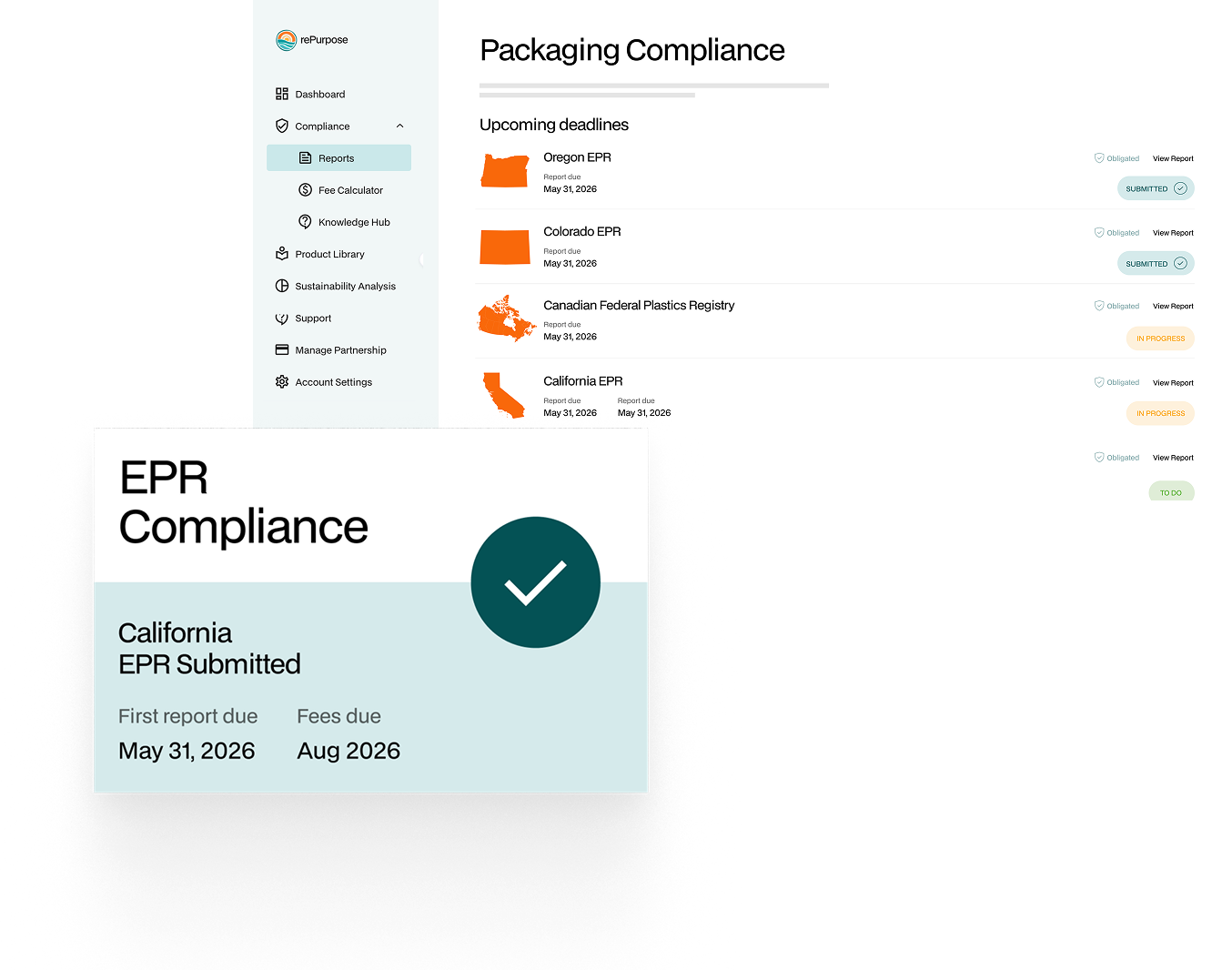
Specifically, for the May 31, 2026 reporting deadline, we’ll need your 2025 packaging supply data, supplier specs and sales data by state, your team’s point person for EPR, and your packaging changes from 2025 for California source reduction tracking.

We’ll provide you with a North American obligation assessment, automatic deadline tracking across every state, material categorization and fee calculations, state-by-state report generation, California source reduction pathway classification, fee forecasting so you know what's coming before the invoice arrives, dedicated compliance experts reviewing everything and walking you through submission, and continual regulatory monitoring so that you don’t have to read through 1,000 pages as regulations evolve.

EPR reporting requires detailed packaging data, which can be complex to compile and varies by state. Brands must be prepared to report on:

  • Types and amounts of packaging materials used (including component-level details like material type and color)
  • Product exemptions and covered materials
  • Packaging weights and recyclability information
  • Packaging format and component-level detail
  • Material categories (there are 140+ categories across different states)
  • Sales data by state


To meet these requirements, you'll need data from both internal and supplier sources.

Yes, EPR fees can often be significantly reduced through proper optimization strategies:

  • Smart Data Collection: Knowing exactly which data to collect (and which to skip) prevents over-reporting and reduces unnecessary fees. Expert platforms help you avoid "boiling the ocean" hunting for irrelevant information.
  • Reporting Option Selection: Many states offer different reporting options for low-volume producers. Expert analysis can identify the most cost-effective choice. For example, rePurpose saved low-volume clients an average of $3,750 in fees by selecting optimal reporting pathways—one brand paid only $360 instead of $4,400.
  • Accurate Material Categorization: With 140+ material categories across different states, proper classification is crucial. Misclassification can lead to overpayment, while expert categorization ensures you pay only what's required.
  • Exemption Identification: Many products qualify for exemptions that brands miss without expert guidance. Identifying exempt products and covered materials can significantly reduce your fee burden.
  • Multi-State Efficiency: Using the right data architecture from the start saves money across all EPR states. Your initial investment pays dividends as you expand compliance to additional states.

You have three main options to navigate EPR compliance, each with distinct advantages and drawbacks:

DIY Approach:

  • Pros: Lower upfront cost, full control over process
  • Cons: Requires 2+ months of internal work, high risk of errors, no ongoing support, difficult to optimize fees, requires deep regulatory expertise

Consultants:

  • Pros: Expert guidance, customized service
  • Cons: Expensive ($40,000-$120,000+), project-based with no ongoing platform, limited scalability across multiple states, still requires significant internal coordination

Software Platforms (like rePurpose):

  • Pros: Reduces process to ~2 weeks, automated multi-state compliance, ongoing support, fee optimization, scalable across all EPR states, comprehensive data management
  • Cons: Not all software platforms are created equal

Most brands find software platforms offer the best balance of cost, efficiency, and ongoing value, especially for companies planning to operate in multiple EPR states.

Get a clear EPR compliance plan with expert guidance

What deadlines and fees you need to prepare for
Which state packaging regulations apply to your products
Where your current compliance risks might be
Smiling woman with long dark hair wearing a yellow top standing in front of a leafy green bush with yellow flowers.
Anjali Malpani
Smiling woman with long blonde hair wearing a light green top outdoors with green leafy background.
Jenny Hanson
Smiling man with short gray hair and beard wearing a navy blazer and checkered shirt against a gray background.
Joe Ritano
Smiling woman with long wavy brown hair wearing a blue blazer and necklace, outdoors with greenery in the background.
Lindsay Kenefick