
ResourcesBlog
Solving the Plastic Crisis At Scale: Reflections From My Boundary Breakers Conversation

Solving the Plastic Crisis At Scale: Reflections From My Boundary Breakers Conversation

Written by 
Svanika Balasubramanian
Published on 
November 30, 2025

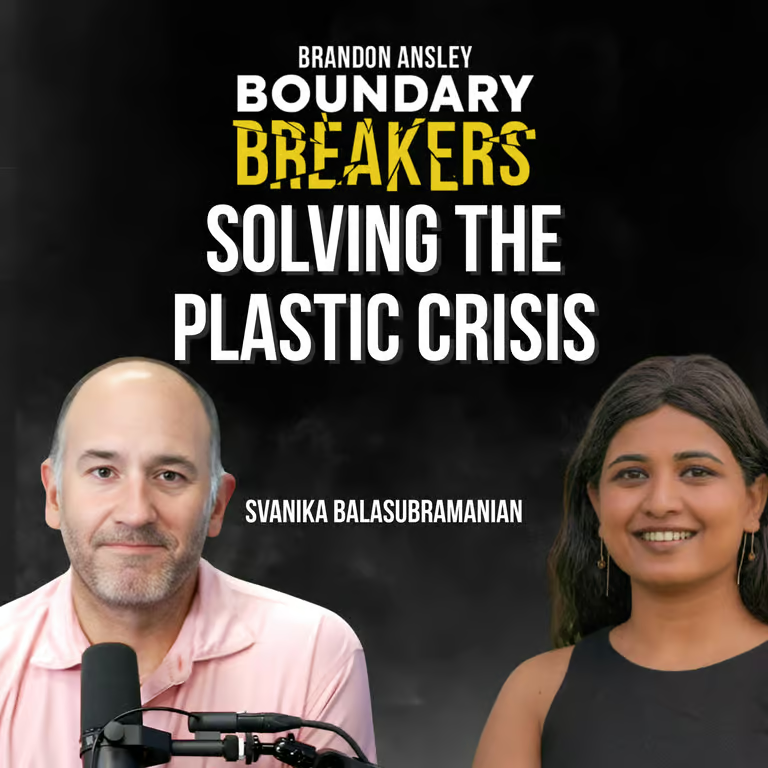
Last week, I sat down with the Boundary Breakers team for a conversation about the work we’re doing at rePurpose Global - and, more importantly, about the lived reality of trying to build a business that is both mission first and operationally excellent.

You can find the full podcast recording here on their youtube page. 

I walked into the studio thinking we’d talk about plastic waste, circular systems, and sustainability action. And we did. But what surprised me was how much of our conversation centered on the invisible emotional and operational terrain of purpose-driven work - the pieces we rarely linger too long on as founders, leaders, or operators.

Here are the five takeaways from the conversation that stayed with me.

1. Purpose isn’t the opposite of profitability — it’s the only durable path to it.

I said this on the podcast, and it’s the one message I wish every founder could hear early: we have to stop treating purpose like a tax on growth. The companies that are thriving today - with consumers, with regulators, and with investors - are the ones who recognize that impact and profitability compound each other.

When companies come to rePurpose Global to measure their plastic footprint, redesign packaging, or invest in plastic recovery, they’re not doing it out of charity. They’re doing it because the economics of sustainability are shifting rapidly in their favor.

But here’s what I emphasized in our conversation: Profitability is a short-term game. Purpose is a long-term one. Profit helps a business survive; purpose helps it endure.

Profit can give you a quarter. Purpose gives you a decade.

And in a world defined by volatility -  regulatory, geopolitical, or environmental - purpose has become one of the most underrated drivers of resilience. It anchors companies through cycles, disruption, and scrutiny. It creates strategic clarity when the market shifts. And it gives teams something sturdier than margin targets to rally around.

Purpose isn’t a trade-off. It’s an investment in the longevity of the business itself.

2. Clarity is a requirement for progress. 

One of the most honest parts of our podcast conversation was acknowledging what the real barrier to sustainability action is today. It’s not apathy. It’s not even budgets.

It’s uncertainty.

Regulations are changing faster than most companies can update their internal playbooks. 

In the packaging compliance space, for example, U.S. states are passing EPR laws at different speeds. The EU is rewriting packaging rules while also rolling out Digital Product Passports. Retailers are adding their own requirements on top of these regulatory reporting needs.

Most companies aren’t struggling with intent, they’re struggling with interpretation.
And yet, progress can’t wait for perfect information.

That’s why I believe so strongly that clarity isn’t just helpful, it’s required for the kind of progress the world needs from us right now. Even partial clarity. Even clarity that will evolve.

At rePurpose, much of our work over the last year has been about giving companies precisely that. We introduced the rePurpose Compliance Platform - a software solution built to help brands navigate regulatory uncertainty, track requirements across markets, and comply with rapidly evolving laws in one place. It’s designed for exactly the world we’re in: one where staying still is riskier than moving forward imperfectly.

You can also read more about my call for harmonization across the ESG sectors here to simplify reporting for consumer companies here.

3. Integration is what will actually scale the circular economy.

This was a theme I’ve spoken about often: the bottleneck in the circular economy is integration across the different parts of the material supply chain. 

We don’t need one more “recyclable” material that can’t be processed at scale. We don’t need one more isolated impact initiative that doesn’t speak to a company’s supply chain. We need upstream and downstream to finally talk to each other.

That means packaging design teams sitting at the same table as waste management engineers. It means retailers sharing data with their brands, and brands sharing data with recyclers. It means companies treating waste systems as part of the supply chain - not as a black box. 

Every single company that manufactures packaging should have complete visibility into what happens to that material after it is finished being used. 

Here is a longer article on the need for data sharing across the circular economy. 

4. There is no impact without accountability — and no accountability without data.

This was perhaps the most personal part of our conversation. If there’s one thing I’ve learned at rePurpose, it’s that impact doesn’t grow on hope. Scale requires proof.

And proof requires infrastructure - the right tools, the right systems, the right incentives.

That’s exactly why we built reTrace, our proprietary waste management traceability platform. We invested years of time, energy, and engineering resources into building what we believe is the gold standard for traceability in the global waste sector.

Why did we take that on when the easier path was to rely on manual reporting and auditing?

Because fundamentally we believed that attracting meaningful capital flows into waste recovery absolutely requires complete visibility into the full supply chain.

Every waste ecosystem is a maze of formal players, informal workers, middlemen, aggregators, transporters, processors, recyclers - each operating with a different level of structure depending on geography. But if we wanted to scale plastic recovery globally, we needed visibility into all of it.

reTrace gives us and the brands we work with a transparent view of what happens to every kilogram recovered through our network, no matter how complex the chain or where in the world it sits. It independently validates movement, verifies processing, and links impact back to each funder with a level of precision and confidence this industry has never had before.

Accountability is not a reporting requirement. It’s a precondition for real impact and real systems change.

5. If you’re building something meaningful, expect resistance - and build anyway.

We ended the podcast reflecting on the emotional reality of doing this work. Purpose-driven builders don’t just face business challenges. They face structural ones. Political ones. Psychological ones.

You are often early. You are often asked to justify your existence twice as hard as traditional businesses.

But change intrinsically attracts friction. And that friction is often a sign that you’re pushing into territory the world hasn’t yet learned to value.

Every new regulatory shift, every retailer requirement, every brand that decides to measure its footprint or redesign its packaging - these are proof points to us at rePurpose that the field is indeed moving. 

The accumulation of unglamorous, persistent work is what bends systems.

And so my final thought - We don’t get to choose the pace at which the world around us will change. But we do get to choose whether we show up for it.

Ready to transform your packaging strategy?

Join 500+ CPG brands who've streamlined their packaging compliance and claims with rePurpose Global.

ResourcesBlog
Solving the Plastic Crisis At Scale: Reflections From My Boundary Breakers Conversation

Solving the Plastic Crisis At Scale: Reflections From My Boundary Breakers Conversation

Written by 
Svanika Balasubramanian
Published on 
November 30, 2025
Solving the Plastic Crisis At Scale: Reflections From My Boundary Breakers Conversation

Last week, I sat down with the Boundary Breakers team for a conversation about the work we’re doing at rePurpose Global - and, more importantly, about the lived reality of trying to build a business that is both mission first and operationally excellent.

You can find the full podcast recording here on their youtube page. 

I walked into the studio thinking we’d talk about plastic waste, circular systems, and sustainability action. And we did. But what surprised me was how much of our conversation centered on the invisible emotional and operational terrain of purpose-driven work - the pieces we rarely linger too long on as founders, leaders, or operators.

Here are the five takeaways from the conversation that stayed with me.

1. Purpose isn’t the opposite of profitability — it’s the only durable path to it.

I said this on the podcast, and it’s the one message I wish every founder could hear early: we have to stop treating purpose like a tax on growth. The companies that are thriving today - with consumers, with regulators, and with investors - are the ones who recognize that impact and profitability compound each other.

When companies come to rePurpose Global to measure their plastic footprint, redesign packaging, or invest in plastic recovery, they’re not doing it out of charity. They’re doing it because the economics of sustainability are shifting rapidly in their favor.

But here’s what I emphasized in our conversation: Profitability is a short-term game. Purpose is a long-term one. Profit helps a business survive; purpose helps it endure.

Profit can give you a quarter. Purpose gives you a decade.

And in a world defined by volatility -  regulatory, geopolitical, or environmental - purpose has become one of the most underrated drivers of resilience. It anchors companies through cycles, disruption, and scrutiny. It creates strategic clarity when the market shifts. And it gives teams something sturdier than margin targets to rally around.

Purpose isn’t a trade-off. It’s an investment in the longevity of the business itself.

2. Clarity is a requirement for progress. 

One of the most honest parts of our podcast conversation was acknowledging what the real barrier to sustainability action is today. It’s not apathy. It’s not even budgets.

It’s uncertainty.

Regulations are changing faster than most companies can update their internal playbooks. 

In the packaging compliance space, for example, U.S. states are passing EPR laws at different speeds. The EU is rewriting packaging rules while also rolling out Digital Product Passports. Retailers are adding their own requirements on top of these regulatory reporting needs.

Most companies aren’t struggling with intent, they’re struggling with interpretation.
And yet, progress can’t wait for perfect information.

That’s why I believe so strongly that clarity isn’t just helpful, it’s required for the kind of progress the world needs from us right now. Even partial clarity. Even clarity that will evolve.

At rePurpose, much of our work over the last year has been about giving companies precisely that. We introduced the rePurpose Compliance Platform - a software solution built to help brands navigate regulatory uncertainty, track requirements across markets, and comply with rapidly evolving laws in one place. It’s designed for exactly the world we’re in: one where staying still is riskier than moving forward imperfectly.

You can also read more about my call for harmonization across the ESG sectors here to simplify reporting for consumer companies here.

3. Integration is what will actually scale the circular economy.

This was a theme I’ve spoken about often: the bottleneck in the circular economy is integration across the different parts of the material supply chain. 

We don’t need one more “recyclable” material that can’t be processed at scale. We don’t need one more isolated impact initiative that doesn’t speak to a company’s supply chain. We need upstream and downstream to finally talk to each other.

That means packaging design teams sitting at the same table as waste management engineers. It means retailers sharing data with their brands, and brands sharing data with recyclers. It means companies treating waste systems as part of the supply chain - not as a black box. 

Every single company that manufactures packaging should have complete visibility into what happens to that material after it is finished being used. 

Here is a longer article on the need for data sharing across the circular economy. 

4. There is no impact without accountability — and no accountability without data.

This was perhaps the most personal part of our conversation. If there’s one thing I’ve learned at rePurpose, it’s that impact doesn’t grow on hope. Scale requires proof.

And proof requires infrastructure - the right tools, the right systems, the right incentives.

That’s exactly why we built reTrace, our proprietary waste management traceability platform. We invested years of time, energy, and engineering resources into building what we believe is the gold standard for traceability in the global waste sector.

Why did we take that on when the easier path was to rely on manual reporting and auditing?

Because fundamentally we believed that attracting meaningful capital flows into waste recovery absolutely requires complete visibility into the full supply chain.

Every waste ecosystem is a maze of formal players, informal workers, middlemen, aggregators, transporters, processors, recyclers - each operating with a different level of structure depending on geography. But if we wanted to scale plastic recovery globally, we needed visibility into all of it.

reTrace gives us and the brands we work with a transparent view of what happens to every kilogram recovered through our network, no matter how complex the chain or where in the world it sits. It independently validates movement, verifies processing, and links impact back to each funder with a level of precision and confidence this industry has never had before.

Accountability is not a reporting requirement. It’s a precondition for real impact and real systems change.

5. If you’re building something meaningful, expect resistance - and build anyway.

We ended the podcast reflecting on the emotional reality of doing this work. Purpose-driven builders don’t just face business challenges. They face structural ones. Political ones. Psychological ones.

You are often early. You are often asked to justify your existence twice as hard as traditional businesses.

But change intrinsically attracts friction. And that friction is often a sign that you’re pushing into territory the world hasn’t yet learned to value.

Every new regulatory shift, every retailer requirement, every brand that decides to measure its footprint or redesign its packaging - these are proof points to us at rePurpose that the field is indeed moving. 

The accumulation of unglamorous, persistent work is what bends systems.

And so my final thought - We don’t get to choose the pace at which the world around us will change. But we do get to choose whether we show up for it.

Ready to transform your packaging strategy?

Join 500+ CPG brands who've streamlined their packaging compliance and claims with rePurpose Global.