
The deadline is close, and the questions are real. On April 29th, 2026, rePurpose brought brands together for "Base Camp to May 31," the latest chapter in our unPacked webinar series dedicated to making EPR compliance manageable. Think of rePurpose as your guide for the climb: from gathering your data to categorizing materials to reaching the summit with your reports submitted.
To wrap up the session, we opened the floor for an unrecorded Q&A. We're sharing those exchanges here so attendees can reference them — and so every brand reading this knows the questions keeping them up at night are keeping others up too.
Please note that the answers below are for general reference only. Please consult your own legal counsel to determine the reporting obligations specific to your business.
rePurpose Platform
Q: Does rePurpose software help with tracking source reduction, such as Oregon's LCA bonuses, as well as California’s annual source reduction report?
A: Yes! We support California source reduction plans (due Aug 1), annual source reduction progress reports (due May 31), and Colorado eco-modulation reports. Our software does not include LCAs, but we work with trusted LCA partners that can help with this.
Q: What does your program cost?
A: There are a couple of factors that influence our pricing. You can schedule 15 minutes with our team to talk through your specific needs and learn more today.
Q: Some data is sensitive, like sales data. How can sensitive company data be protected in the database? Is there a tool that companies can buy and run internally?
A: Our platform uses best-in-class IT security protocols to protect our customers’ data. Our team is happy to provide a more in-depth technical explainer. Schedule time with our team.
Q: Is your software applicable to PPWR?
A: Not at this time, but we are building towards supporting PPWR.
Q: Is your platform able to calculate fees across all states or only per state? If we make a packaging change, it would be nationwide, not by state.
A: Yes, you can see the total national fees in addition to fees by state.
Q: There are differences between what materials are or are not included in the different states. Is there a guide in your platform that flags that?
A: Absolutely. Our platform uses the most up-to-date CAA guidance for covered materials by state and will account for each state’s specifications in reporting.
Obligated Producers
Disclaimer: Because producer obligations vary by jurisdiction and business, rePurpose recommends consulting qualified legal counsel to determine your specific reporting requirements. These responses do not constitute legal advice.
Q: As a co-packer, if our packaging is unbranded, but has a "MANUFACTURED FOR [X company] statement on the packaging, does that shift reporting responsibility to [X company]?
A: Each producer must determine obligations with their own legal counsel. rePurpose does not provide legal advice since every producer scenario and value chain is different. That said, our general interpretation is that the brand owner is typically responsible for EPR obligations, unless you are also selling products with packaging into the state yourself (with or without your brand).
Q: Do small producers with less than $1 million in annual gross sales in California need to submit a baseline report?
A: Each producer must determine obligations with their own legal counsel. rePurpose does not provide legal advice since every producer scenario and value chain is different. That said, our understanding is that exempt producers don’t need to submit a source reduction report if they are not obligated under California EPR reporting. However, future action may be required when you do become obligated. We advise reaching out to CAA or CalRecycle then to determine what your source reduction baseline obligations would be.
Q: We have a 3PL who packs and ships all our orders. Are they responsible for reporting the tertiary packaging required to ship? What if that tertiary packaging has our branding on it?
A: Each producer must determine obligations with their own legal counsel. rePurpose does not provide legal advice since every producer scenario and value chain is different. That said, in general, if tertiary packaging has your brand on it, then more likely than not, you’re obligated for it.
Some states have specific carve-outs for 3PLs. For example, if the 3PL is shipping e-commerce packages and they’re adding packaging to it, then they may be responsible for it. We would have to look at how the supply chain is structured and see how they may be excluded. In Oregon, pallet wrap added by a party who is not the producer of the palletized products does not need to report it.
Q: Isn’t Oregon's program paused while they figure out the lawsuit?
A: There are several ongoing lawsuits, but the program runs as usual. Fees continue to be collected, and financial plans for deployment are in the works. Additionally, for context, the existing lawsuits provide a preliminary injunction to a subset of producers (e.g., NAW members), but it doesn’t apply to most producers.
Q: We have a customer for whom we make private label products (they own the brand). They're trying to push the reporting to us. My understanding after reading the various state bills is that the brand owner is responsible. Is my understanding correct?
A: Disclaimer that this is not legal advice. But from this question and context provided, if you’re a contract manufacturer/value chain player supplying to the brand, the brand that is supplying into the state is responsible for reporting.
Q: Regarding Minnesota’s simplified reporting: none of our packaging reaches the consumer EXCEPT for hang tags (paper-cardstock). Would we be considered an obligated producer and need to report the hang tag data?
A: Please check the tonnage and revenue thresholds for Minnesota in order to determine this.
Q: If a percentage of a plastic material is less than 5%, am I still obligated to report since it is technically recyclable?
A: (Assuming this question refers to California.) There are no de minimis plastic material exemptions approved at this time, so after considering the dominant material rules for identifying CMCs (which includes considerations of whether a component is with or without plastic), the plastic weight and component count must then still be calculated for reporting purposes, even if the package is recyclable.
Q: We sell to large retailers who cook items at store sites and package them there for sale to consumers. We don't have visibility into what states products go to, how much goes to each state, or how they package it. What's our EPR responsibility?
A: We would need to discuss additional details to understand your value chain. A good starting resource is the producer definition and the covered materials guides for each state. They can be accessed here.
B2B
Q: How do these EPR regulations impact business-to-business sales? We do not sell direct-to-consumer and are curious how we need to approach EPR reporting.
Different states treat this differently. It is also important to note that if your product ultimately ends up with a consumer (even if you sell to a business, e.g., retail), that would be considered B2C sales. B2B-only sales are excluded in some states but not in all. Reach out to our team for more.
Q: For direct sales companies, does Colorado consider a consultant's work from home business B2B?
A: This depends on what you’re referring to. For instance, are you supplying products? If so, we evaluate based on whether the products end up in the residential waste stream. If you supply products to customers where the products go into the consumer waste stream, then that could make you obligated to report.
Q: For B2B, you sell packaging to businesses, and they send products in packaging to their customers. We do not have visibility on where the packaging is shipped. How do we handle this?
A: B2B packaging is specific to supplying packaging that doesn’t make its way to the consumer stream. The question is, ultimately: does your product end up with the consumer or not? Shrink wrap, pallet wrap, and other packaging that doesn’t end up with the consumer may be excluded from states that have B2B exclusions. Our app is built to account for these exclusions.
Exemptions
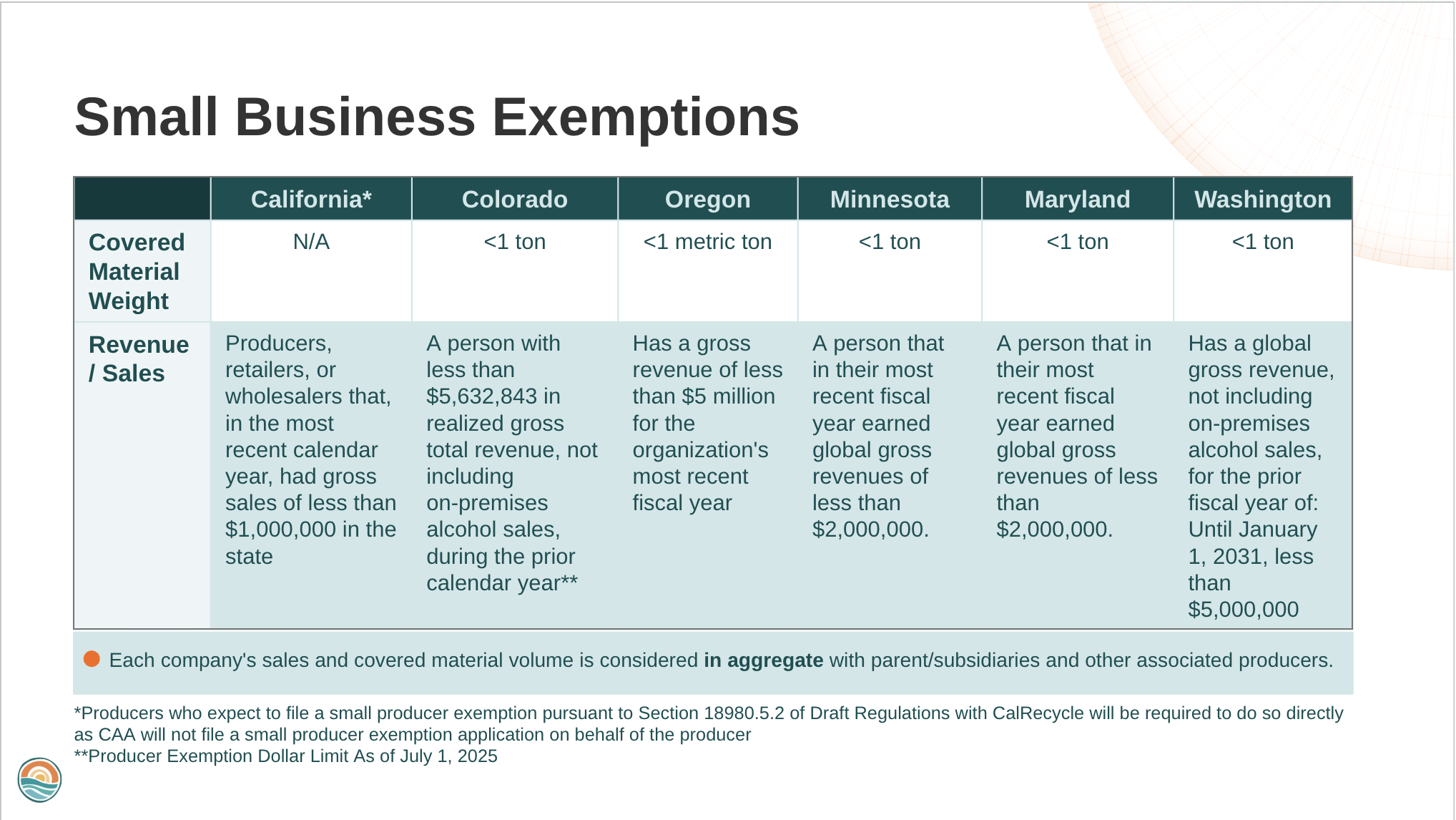
Q: We believe that we qualify for a small producer exemption. Can you share your thoughts on what, if anything, small producers need to do at this point? How do we confirm that we are exempt in each state?
A: Please use this resource as a guide for small producer exemptions. If you need further guidance or confirmation, take our EPR obligation survey.
Q: Do you have a list of each state's qualification in $ or # to be classified as an exempt producer?
A: Please use this resource as a guide for small producer exemptions. If you need further guidance or confirmation, take our EPR obligation survey.
Q: Would desiccants be reported in the emerging states (WA, MN, MD)?
A: CAA has clarified that desiccants would likely not be considered covered material in the emerging states. We advise best practice to highlight any exclusions and reasoning in your methodology.
PCR
Q: Can you discuss PCR reporting requirements in Colorado and specifically explain Mass Balance Credit and when that might be used?
A: Colorado requires mandatory PCR (Post-Consumer Recycled content) reporting this year. Submissions must include:
- Supply data
- PCR content, broken down by material reporting category for ecomodulation reporting and at the material class level for EPR supply reports
Eco-Modulation Bonus (Voluntary):
Producers may qualify for an eco-modulation bonus if the PCR content in their covered materials exceeds the threshold for their applicable material category. Eligible producers receive a 5% reduction in dues for the amount of PCR content in materials.
Mass Balance Method:
If you use the Mass Balance method to calculate PCR content, only the proportional allocation method is permitted.
Q: Are there attestation requirements?
A: For PCR in CA, it needs to be APR-certified. For CO, you may be asked for attestations on request and will have to self-attest while submitting your report.
Q: Is there a benefit to complying with APR guidelines and demonstrating that conformance?
A: Yes, APR guidelines will help determine the recyclability of plastic packaging. This helps to confirm packaging recyclability, make you eligible for certain ecomodulation benefits, and could result in better reporting categories in most cases.
Covered Materials
Q: Is tertiary packaging, including kraft cartons, pallets, and shrink wrap, exempt from simplified reports in WA, MN, and MD?
A: Correct, tertiary packaging is not to be reported this year for simplified reporting states (and Colorado, where these packaging materials are not supplied to the consumer for personal, non-commercial use).
Q: Will packaged single-use paper plates and plastic cutlery packs be in scope of simplified reporting for emerging states (MN, MD, WA)?
A: These are covered materials and in scope. Some of the emerging states have specified food service packaging separately, while others, like Washington, have folded "to serve" terminology into the main definition of packaging.
Q: Question about the food service industry business in California: Does the required reporting only include packaging that makes it to the customer (clamshells, utensils, etc.), or would food prep disposables (ziplocks, piping bags, etc.) be included in reporting requirements?
A: California includes B2B packaging as well as B2C packaging, so most of these single-use packaging materials would typically be in scope of the law.
Q: When submitting information, the inclusion of tertiary packaging is required by California, but does that include pallets? And if so, which other states are also included with that requirement?
A: Unique to CA, single-use pallets need to be reported. If your pallets don’t meet the definition of refill/reuse, then they should be included in your supply report.
To simplify reporting for this year, the emerging states (Minnesota, Maryland, Washington) with simplified reporting do not include pallets. To note, Oregon does have a B2B packaging inclusion but specifically excludes pallets.
Q: California has a definition for Laminate. Is there a definition for Laminate in CO and OR?
A: All definitions are mentioned in the CMC list of each state. These are available in the Producer Portal.
Q: Regarding active packaging, are EPR regulations focusing mainly on the plastic content, or would the manufacturer have to report on the active ingredients as well?
A: The reference to “active ingredients” here is unclear. For EPR, reporting is limited to packaging and paper products, and different states have different covered materials eligible for packaging EPR reporting.
Q: We just have one product using an HDPE bottle. We report this product to CalRecycle under RPPC Law. Do we still have to report it again under SB 54?
A: Our interpretation is that RPPC law does not exempt producers from SB 54. Accordingly, one is advised to report. However, if your bottle is covered under California’s Bottle Bill, the primary packaging would not be covered material under SB 54. It is best to confirm your case with the RPPC authorities and CalRecycle for additional clarity.
Q: Are plastic single-use grocery bags required to be reported (specifically in MN)?
A: Producers are advised to review the producer guidance and covered materials documents in each state to determine covered materials. That said, it is our understanding that plastic bags would be in-scope per the definition of packaging in MN.
Q: Any thoughts on counting "stretch wrap" as a plastic component in California?
A: Yes, this would need to be included in component counts.
Data Reporting
Q: Are we reporting 2023 data or 2024 data? I thought the previous year was what needed to be reported.
A: 2023 data reporting is strictly for California’s Baseline Producer Supply Report for Source Reduction. All other reporting requires 2025 calendar year data. If you missed your 2025 reporting for Oregon and Colorado, you’re still required to report on the 2024 data.
Q: Some states mention global gross revenue vs. others just mention annual revenue. Should we just consider global gross revenue for all the states to see if we qualify?
A: CAA applies gross global revenue for every US state, except for California, which uses gross sales revenue in California.
Q: If I have a bag with a zipper, and there is a tear-off strip, does that tear strip add to the count?
A: Yes, as separable components, they’re counted separately. So the bag, zipper, and strip make 3 components.
Q: Can you elaborate more on why the bag and zipper are not a count of 1? They are permanently bonded together as a single unit with no expectation from the consumer to separate.
A: CalRecycle rules to account for every component. This example is specifically cited in the CA Source Reduction Guidance
Q: What is the best approach to calculating labels and the polymer adhesive in California?
A: As far as adhesives and inks go, it really depends on whether it’s homogenous with the parent component. If it’s a plastic-based adhesive on a paper bag, then you still need to report for that plastic amount. The key is really to identify material breakdowns. Please refer to CA Source Reduction guidance issued by CalRecycle for more.
Q: Do ISO 14021 and APR standards overlap?
A: ISO sets the standard, and APR certifications are based on ISO standards. California requires APR certifications for PCR verification, while Colorado allows more flexibility.
Q: What does LCA stand for in Oregon's packaging Eco modulation bonuses?
A: Life Cycle Assessment
Q: We were asked by an apparel brand to report packaging data that we sell to a licensee – no consumer goods at all. Why are they collecting this if California requires single-use only? (Why are apparel brands requiring the collection of packaging data?)
A: Brands obligated as producers under Packaging EPR will be required to report packaging data for covered materials. Apparel packaging does not appear to be excluded from the scope; hence, it is likely why the brands are reaching out to collect data from their packaging suppliers.
Q: Simplified reporting for Minnesota, Maryland, and Washington include 8 categories that are "consumer" only. Will detailed reporting require only consumer/retail categories in the future?
A: The regulations are not finalized, so we cannot be sure about future reporting requirements. For this reporting cycle, only packaging supplied to consumers for personal, non-commercial use needs to be reported.
California Source Reduction
Q: Is there an official processing or approval timeline for the California 2023 Baseline Report that must be completed prior to submitting our Annual Source Reduction Report?
A: There is no official processing time, but you need the 2023 Baseline and 2025 Supply Report submitted to CAA before you can submit the Annual Source Reduction Report for 2026.
Q: We started doing business in California in 2025 only. Do we have to report for 2023?
A: Reach out to CAA about your situation and how baseline affects this since you don’t have 2023 reporting available. For mergers & acquisitions, also notify CAA through their support to see how you should be reporting (i.e., as parent or child brand).
Q: For California, why do we have to report 2023 again? Is 2024 completely skipped?
A: Your 2023 supply report will serve as your Source Reduction baseline, and your 2026 supply report will be based on your 2025 data. 2024 data is not required for your California reporting. For more information, download our California EPR compliance eBook.
Q: If we have not created a baseline 2023 report, do we need to create one before starting 2025 reporting?
A: The right chronology is the 2023 baseline report, and then the 2026 supply report and the source reduction progress report. Baseline reports should be prioritized.
Q: In California, if our company sales were under $1 million do we need to do anything prior to May 31st?
A: You must file for a small producer exemption with CalRecycle via their PEPRS portal.
Q: We did a 2019 program eliminating plastic packaging in consumer products. Our plastic is ~2% of total waste. What do we do for the 25% commitment and reduction plan when the cupboard is bare?
A: e recommend documenting your historical source reduction efforts in your ISR plans and Source Reduction progress reports, and explaining this in the qualitative free form responses. For the remainder, we recommend presenting a plan that is realistic and achievable from where you are right now. We also recommend looking beyond consumer packaging and exploring B2B packaging for plastic source reduction.
Q: Does California require PCR to be third-party certified to be reportable?
A: Yes, it requires APR-certified PCR under source reduction.
Q: Are there any exemptions for the source reduction requirements? B2B/transport/DG/medical devices?
A: All exemptions are included in the covered material and producer guidance documents, as well as the regulations (recently finalized). These include medical devices, drugs, etc.
Q: Our plastic in consumer packaging is from 'polycoated paper' for color graphics. What are the opportunities to reduce when the plastic weight is just part of the paper?
A: We can explore this further, but plastic reduction can also come from secondary and tertiary packaging, as well as uncoated or reusable paper formats, where possible.
Q: For California filing, you mentioned that the baseline report has the 30-day window and showed a June submission. How can you do a reduction report on May 31 without the baseline report?
A: SB 54 regulations were finalized on May 1st. May 31 falls on a Sunday, so CAA clarified that the latest date for reporting (baseline report, supply data report, and source reduction report) would be the next business day – June 1, 2026.
Fees
Q: What kind of fees can be charged if we are late/have not complied?
A: It’ll likely be a certain percentage of your EPR fees. Oregon and Colorado are implementing fees on late reports. California’s regulations are still being finalized, but we can expect late fees to be implemented after reporting is due.
Q: Colorado guidance says you can pay a fee if you're unable to report PCR guidance in their Mandatory PCR reporting. Do you know what the fee amounts are or how they are calculated?
A: There are no fees associated with this year’s PCR reporting. This is a disclosure requirement. If you do have PCR, then you can apply for reduced fees. From flat EPR reporting, there are no PCR fees.
Related posts

.avif)