

The short answer: brands that don't comply with packaging EPR face escalating warnings, a spot on a public non-compliance list, and back fees for every year missed and civil penalties. Oregon and Colorado are now contacting non-compliant brands directly. Oregon fines can reach $25,000 per day, and Colorado's start at $5,000 for the first day.
Extended producer responsibility (EPR) for packaging requires brands to report how much packaging they sell into a state and pay fees that fund recycling. Seven US states have packaging EPR laws, and Oregon and Colorado are the first to go after brands that haven't complied.
New to EPR? Download our step-by-step EPR guide to learn how it works and where to start.
If your brand sells packaged products into Oregon or Colorado and hasn't reported to the state's EPR program yet, regulators are now contacting you directly.
On October 19, 2026, Oregon's Department of Environmental Quality (DEQ) sent a formal warning letter to a brand that hadn't reported or paid under Oregon's Recycling Modernization Act (RMA), the state's packaging EPR law. The brand shared it with us. We've redacted their name, but everything else is exactly as they received it.
It's a one-page letter with a simple point: brands that still haven't complied now risk penalties.
One day later, on October 20, 2026, Colorado's Department of Public Health and Environment (CDPHE) emailed its own notices to producers that may be out of compliance. Two states sent notices in two days. EPR enforcement is no longer a one-state story.
Oregon and Colorado EPR enforcement at a glance
What does an Oregon EPR warning letter say?
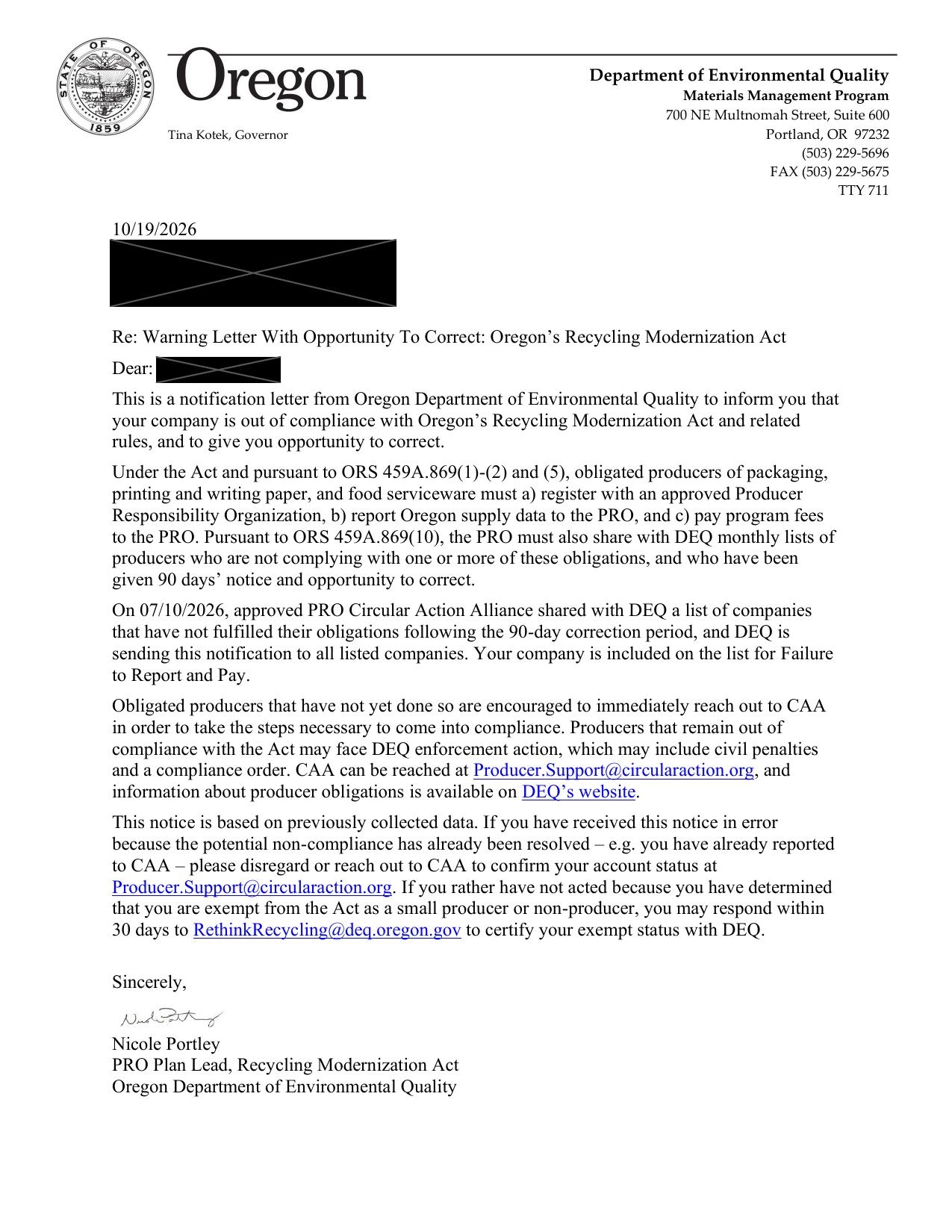
The letter makes four key points:
- Every brand selling packaging into Oregon has three jobs. Sign up with the state's program operator, Circular Action Alliance (CAA). Tell CAA how much packaging you sold into Oregon. Pay the fees that follow.
- CAA reports brands that don't do those jobs. Every month, CAA sends DEQ a list of companies that ignored a 90-day notice to fix the problem.
- This brand was on that list. The reason given: failure to report and pay.
- Penalties are now on the table. Brands that stay out of compliance may face enforcement action, including civil penalties and a compliance order.
The letter offers two exits: get compliant with CAA right away, or prove within 30 days that your company is exempt.
What does Colorado's EPR notice say?
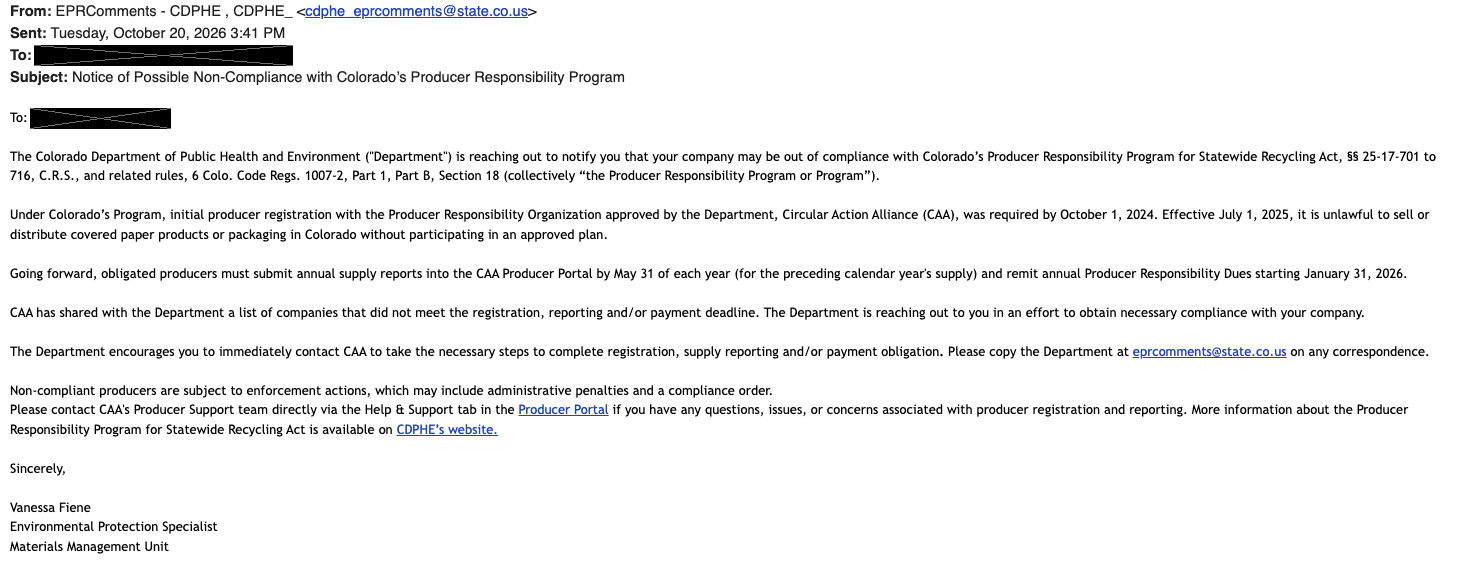
Colorado's email says the company "may be" out of compliance, but the details show the risk is real:
- The deadlines have long passed. Brands had to register with CAA by October 1, 2024. Since July 1, 2025, it has been unlawful to sell or distribute covered packaging or paper products in Colorado without taking part in the program.
- Reporting and dues are now yearly. Brands report last year's packaging sales to CAA by May 31 each year, and dues have been owed since January 31, 2026.
- CAA handed CDPHE a list. It names companies that missed the registration, reporting or payment deadline.
- Penalties are possible. Non-compliant producers can face administrative penalties and a compliance order.
The ask is simple: contact CAA right away, and copy CDPHE at eprcomments@state.co.us on any correspondence.
Received a letter or email like this? You don't have to sort it out alone. rePurpose confirms what you owe, builds your overdue reports and gets you back in good standing with CAA, fast. Talk to our EPR team today.
The Real Cost of EPR Noncompliance
For years, plenty of brands treated EPR as a future problem. Oregon and Colorado just made it a present one. Here's what these notices tell us.
1. Enforcement is a running system, not a one-off. DEQ sent its first round of warning letters in March 2026. In April it published a public list of about 250 producers that failed to register, report or pay. This October letter shows the pipeline is still moving, fed by CAA's monthly lists. Colorado's email confirms CAA is handing the same kind of list to regulators there.
2. There's a clear ladder, and every rung is shorter than the last. In Oregon, brands get a 90-day notice from CAA, then a DEQ warning letter with a 30-day window, then a spot on the public list. After that, Oregon’s enforcement process says it can refer a brand for formal enforcement.
3. The penalties are real money. Failing to register is a violation under Oregon law that can cost up to $25,000 per day. Oregon can also ask a court to stop a brand from selling its products in the state. In Colorado, penalties start at $5,000 for the first day and $1,500 for each day after, climbing to $20,000 plus $6,000 a day for repeat violations.
4. Catching up doesn't erase what you owe. Under Oregon's enforcement process, brands found out of compliance pay all fees for the period they were out. Late brands don't save money. They just pay it later, with more risk attached.
5. Your name can go public. Oregon's list of non-compliant producers is posted online. Retailers, partners and competitors can all see it.
6. Oregon and Colorado are first, not last. California, Maryland, Minnesota and Washington also run programs through the same organization, CAA. The playbook Oregon and Colorado are using now is one other states can follow.
Late to EPR? Your catch-up starts with three reports
Brands that started on time are already preparing their next report, due May 31, 2027.
Oregon runs on a yearly cycle: you report last year's packaging sales, and that data sets your fees. DEQ confirms that starting in 2026, each year's report is due by May 31. Colorado's deadline is the same.
A brand starting today isn't facing one report. It's facing three: two overdue reports, back fees, and a third report due in about seven months. Most of that work is the same work: pulling together your packaging data.
The good news: once that data is built, it carries forward. The sooner you build it, the sooner you're back on the same calendar as everyone else.
How to get into EPR compliance: three moves before 2027
You don't need to have it all figured out today. You need to start, and start in the right order.
1. Assess your obligations
Do Oregon's or Colorado's laws apply to your brand? What about other states? Answer these first, so you don't spend money on states that don't apply to you, or miss one that does.
Talk to our team to assess your obligations.
2. Get your packaging data in shape
Every report starts with the same question: what are your packaging components and weights? For most brands, that answer is scattered across spec sheets, supplier files and sales systems. Pulling it together is the biggest job, and it's the one that can't be rushed in May.
Download the Data Readiness Checklist: know exactly what to collect before you start.
3. Catch up on what's overdue, then get ahead
If you've missed earlier reports in Oregon or Colorado, the fastest path back is to file them, settle back fees with CAA and line up your 2027 report at the same time. Doing it in one push means you build your data once and use it three times.
Talk to our EPR team about a catch-up plan.
FAQ
What happens if I don't comply with EPR? In Oregon, the process escalates: a 90-day notice from CAA, a DEQ warning letter with 30 days to correct, a public non-compliance list, then possible civil penalties and a compliance order. Colorado follows a similar path: CAA reports missed deadlines to CDPHE, which can issue administrative penalties and a compliance order. You still owe fees for the time you were out of compliance.
What happens if I don't report my packaging data to CAA? Not reporting counts as non-compliance, just like not registering or not paying. The brand in this post was flagged for failing to report and pay.
Is it illegal to sell in Colorado without complying with EPR? Yes. Since July 1, 2025, Colorado law bars producers from selling or distributing covered packaging and paper products in the state unless they take part in the approved program.
Will other states enforce EPR the same way? Oregon and Colorado are first, but California, Maryland, Minnesota and Washington also run programs through CAA. It's possible that similar escalation could be enforced as those programs mature.
I got a letter or email like this. What do I do first? Don't ignore it. Oregon's letter gives you 30 days to act. Colorado's asks you to contact CAA immediately and copy CDPHE. Contact CAA at Producer.Support@circularaction.org to confirm your status and next steps, then start on your data. You can also reach out to our rePurpose team to get started.
What if we already reported? If you've already reported, confirm your account status with CAA.
What if we think we're exempt? Small producers and companies that aren't the obligated producer can be exempt. In Oregon, you must certify that with DEQ within 30 days at RethinkRecycling@deq.oregon.gov. In Colorado, confirm with CAA and copy CDPHE. Don't assume exemption. Confirm your status.
Isn't Oregon's law tied up in court? Only partly. A court order blocks enforcement against one trade group and companies that were its members as of February 6, 2026. Everyone else remains fully subject to the law.
We're a small brand. Will Oregon really come after us? Yes, if you're an obligated producer. The April public list included companies across many sectors, from food and beverage to fishing gear. Size alone isn't a shield from EPR enforcement unless you qualify for the small producer exemption.
Does catching up now really help if we owe back fees anyway? Yes. Back fees are owed either way. Acting now stops penalty risk from growing and keeps your name off the public list.
Don't wait for the letter
Most brands getting these notices assumed EPR could wait. Oregon and Colorado have now made clear it can't.
rePurpose is your EPR team, combining compliance software with EPR experts. We figure out where you're obligated, build your packaging data, forecast your fees, file your reports and get you caught up, without adding compliance headcount. Whether you're starting from zero or digging out from a missed deadline, we'll get you back on the same calendar as everyone else.
Book a call with our EPR experts and get a catch-up plan before 2027 arrives.
This post is for general information and isn't legal advice. For questions about your specific situation, contact CAA or your legal counsel.
Sources
- Oregon DEQ: Producers of Covered Products
- Resource Recycling: Oregon DEQ flags 250 producers for RMA noncompliance
- NAW Awaits Ruling After Oregon EPR Trial
Related posts